Is there enough competition in the SME lending sector?
By Tom BelgerFinancial professionals are split over whether they think there is enough competition in the SME lending sector
Section: Features
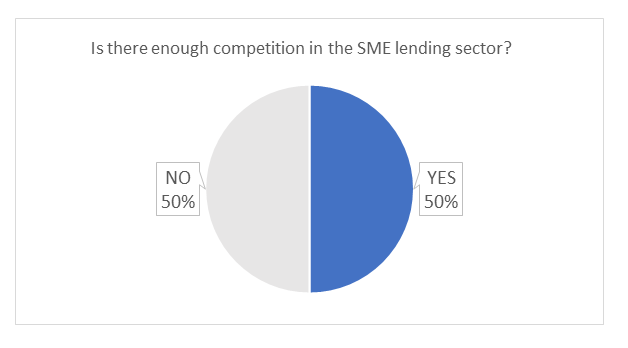
In a recent poll conducted by Bridging & Commercial, the vote was split 50:50 when asked whether there was enough competition in the SME lending market.
The SME funding market is competitive enough
Stuart Law, CEO of Assetz Capital, felt the market was competitive enough and had seen what can happen when a market gets too competitive, taking the bridging finance market as an example.
“Interest rates are being driven to inappropriately low levels for projects that should not be undertaken this late in the cycle.
“A similar situation could arise in SME funding, any substantial increase in competition by lenders would likely drive down interest rates to inappropriate levels that do not fully reflect the risks of lending to businesses in the first place.”
Stuart was worried about the impact low interest rates would have on the SME sector.
“If that was to happen in the SME space, we wouldn't just be seeing some consumers going bankrupt when interest rates finally start to rise a little, we'd see the economic backbone of the country beginning to go bust and huge numbers of job losses as a result of over leveraged businesses falling over.
“This is something we could all do without and I applaud the FCA and the Bank of England's attempts to target specific markets that are overheating, although they are over-compensating considerably in the buy-to-let market.”
Stuart felt that if a small business could not afford interest rates of between 7-10% per annum, there was something quite likely to be wrong with their profitability and cash regeneration and should perhaps not be borrowing in the first place.
“UK businesses rely far more on debt then equity, and equity producing such a low return for a small business with high risks would not be fundable, and neither should debt.
“So, let's hope over competition to mispriced interest rates doesn't come to SME lending too.”
This year has seen some consolidation between SME lenders with 1pm acquiring a number of lenders as well as Close Brothers acquiring Novitas Loans.
Jane Dumeresque, CEO of Folk2Folk, added: “In general, there is a good degree of competition in the SME lending market as borrowers now have more access to finance options than ever before.”
Major banks still dominating the SME market
Joel Perlman, co-founder of OakNorth, was surprised by the results and was concerned that 90% of SMEs in the UK bank with the big five and 90% of these go to their business current account holder as their first port of call when seeking a loan.
“In order to improve competition in the sector, the government needs to create a more proportionate and level playing field for smaller, specialist banks – particularly those that have come to market to address this gap – to effectively compete.
“Brexit creates a unique opportunity in which to do this, acting as a catalyst for the government to review certain regulations such as those relating to risk weightings which currently require smaller banks like us to hold significantly more capital than larger institutions.
“These higher capital requirements are stifling competition and reducing lending to a crucial part of the economy: fast-growth SMEs.”
Christoph Rieche, CEO of iwoca, added: "We all know that the finance market has been dominated by just a few major banks for too long, but this survey underlines just how many businesses suffer from the lack of competition.
“We’re hopeful that schemes like open banking and the Nesta Open Up Challenge will open up the market by giving SMEs control of their banking data.”
Joel also wanted to see government schemes open up to other lenders.
“…Schemes such as the recently announced SME lending partnership between UK Export Finance and the big five banks should be extended to all banks, rather than once again being limited to lenders who have already demonstrated that they’re slow off the mark.”
Letting SMEs know there is competition
John Davies, director at Just Cash Flow PLC and chairman of the Association of Alternative Business Finance, felt it wasn’t a case of more or less competition as there were now plenty of options.
“The issue is one of awareness among SMEs and confidence in using alternative forms of finance.
“One of the key reasons the Association of Alternative Business Finance was formed was to address this 'confidence' issue – now when an SME sees the distinctive AABF logo, they can see they will be dealing with a lender that embraces best industry practice.”
Meanwhile, Christoph added: “With the vast majority of small businesses still only approaching their main bank for finance, it’s clear that more needs to be done to help raise awareness of the alternatives.”
Jane felt that it was not always easy for borrowers to find out which lenders were best able to help them.
“…It is, therefore, increasingly important that we and other finance providers seek to raise greater awareness of the choices available.
“Education on the finance markets will, therefore, help to change the perceptions of the 50% that said it is not competitive enough, when in fact the UK is a global leader in SME lending with a diverse and competitive market.”
Keywords: Assetz Capital, SME finance, SME lenders, commercial finance, Folk2Folk, OakNorth, Just Cash Flow, Association of Alternative Business Finance, Bank referral scheme, iwoca, business lending, SME lenders